1Why we publish this
Part of growing up a mind is learning that every book, every museum, every classroom and every teacher has a bias, a motivation and a point of view. Most do not tell you what it is. Some do not know. We think the honest thing — and the thing that actually teaches critical thinking — is to write ours down.
So this page states, as plainly as we can, what STEM Journey 2027 believes, what it teaches, and what it will not do. You can hold every claim on the trip up against it. That is the opposite of indoctrination: indoctrination works precisely because the perspective is never stated and therefore never examined.
If a claim we make cannot be examined openly, we should not be making it. Hold us to that.
2What we believe
ZOE Living Organization is a Christian nonprofit. The organisation's full Statement of Faith is on the main site. For this journey specifically, the perspective we bring is this:
- God exists, and everything that exists was designed — as if by a wise, loving, powerful mind. We hold that starting from that premise is the most productive way to do science, whether or not the scientist believes in God.
- The Bible, and Jesus in particular, have been powerful forces for good in human history — in the values, the education and the science of the West. One does not need to share our relationship with God to recognise that; people of other faiths and none can and do.
- A relationship with God is relational, not argued into being. Nobody is debated into belief, and no parent, pastor or teacher can make it happen for someone else. It is something a person experiences and chooses for themselves. The mind, however, can block the heart — and honest information removes blocks, for anyone who wants them removed.
- A person may believe in God — or not — and still be a first-rate scientist, engineer or physician. We give students explicit permission to hold both. We ask that they understand, with respect, the people who hold other views.
We use the word relationship rather than faith on purpose. To many people "faith" means an institution. We mean a loving relationship with God, with yourself and with others.
3What we teach
We teach how to think, not what to think. Concretely, over the fourteen days a student will:
- Learn the rules of science and of logic — evidence, falsifiability, inference, the difference between an observation and an interpretation of it.
- Meet well-established, undisputed observations in each of the major sciences that textbooks leave out — not because they are controversial as observations, but because they are inconvenient to the consensus narrative.
- Hear more than one scientific narrative that follows the same evidence, and judge for themselves which explains it best.
- Learn that scientific consensus carries bias — institutional funding, political and philosophical agendas, sponsors who want a result — and learn to spot it.
- Practise the skill the whole journey is built around: state the view you were taught in school calmly, clearly and fairly, explain why intelligent people hold it, present its best arguments — and then show where it fails.
A student may not critique the Darwinian account until they can present it well enough that someone who holds it would say, "yes, that is what I believe, and why." That is the standard.
4What we do — and do not — do
We do
- Present the side of the origins question your student has almost certainly never heard argued seriously.
- Make a safe place to explore your own spirituality and views, and to say them out loud, without condemnation — even if they contradict something.
- Tell students plainly where we stand, and where each institution we visit stands.
- Build up what parents, pastors and teachers have already taught, so that the elders come out looking wiser in the student's eyes.
- Travel in cohorts of ten from one tradition, with adults from that tradition. One adult for every five students.
We do not
- Grade, score, reward or penalise anyone for what they believe.
- Pressure anyone toward a conversion, a denomination or a decision. That is between a person and God.
- Pretend to be neutral or "balanced." The scales students are handed every day are already weighed down on one side, with law behind it. We put weight on the empty pan.
- Teach that you must choose between God and a career in science.
- Promise an outcome for any individual student. Nobody honestly can.
We will not tell you this journey cannot contradict something your student has heard — it will, and that is its purpose. What we will tell you is that it can only serve to strengthen what you have taught them, and give them the chance to confront hard truths and decide for themselves rather than be guided, without options, by a culture that decided for them.
5What each stop openly holds
None of the institutions we visit is neutral, and none pretends to be. We think that is a strength. Here is each one's position so your student knows what they are weighing.

Intelligent design. Accepts an earth billions of years old; takes no position on a global flood. Argues that the strictly materialist Darwinian frame has shut down legitimate lines of inquiry and damaged science for forty years.
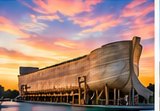
Young-earth creation and the global flood as real history, presented as such, with the evidence they hold supports it.

The Bible and Jesus as powerful influences for good in world history. Appreciable by Jews, Muslims and people of other faiths or none; requires no relationship with God to value.
Your student will notice that the first two disagree with each other on the age of the earth. We do not resolve that for them, and we do not require them to adopt either view. Watching serious people disagree honestly, in the open, about how to read the same evidence is itself one of the most important lessons of the journey. The Smithsonian museums, the Capitol, the Library of Congress and the National Archives hold the other side of the ledger; students bring the same rules of evidence to all of it.
6On "indoctrination"
We are sometimes asked whether this is indoctrination. It is a fair question, and the honest answer has two parts.
First: indoctrination is a narrative presented as settled, by every channel at once, with the alternatives never stated and the cost of dissent made clear. By that definition, the indoctrination already happened — in the textbook, the classroom and the media, every day, with grades, careers and the threat of lawsuits behind it. Even a teacher of deep conviction cannot speak of another view in a public classroom without risking their job.
Second: what we do is the reverse of that. We state our perspective in writing — this page — so it can be examined. We tell students where every institution stands. We require them to argue the other side well before they may criticise it. And we grade nobody on what they conclude.
You cannot be indoctrinated by a view you are free to examine, argue against, and reject. You can only be indoctrinated by the one you were never allowed to hear questioned.
7What we hope for
We cannot predict the outcome for any one student, and we will not pretend to. What we hope for is this: that somewhere in fourteen days — in front of a fossil bed, under a dome, beside a wing, reading a document in the room that holds it — a student has a personal, experiential encounter with God and with the nature God made, and comes home able to decide their own spirituality and life course more intelligently and more joyfully than the culture would have decided it for them.
And we hope their parents, pastors and teachers find that the student came home respecting them more, not less — because the hard questions were faced, in a safe place, and what the elders taught held.
8For parents, pastors and teachers
If you are weighing whether to send a student, this page is meant to be enough to decide whether our perspective is one you can trust them with. If it raises questions, we would rather answer them than have you guess. The interest list on the main page is the simplest way to start that conversation; it commits you to nothing. The plain account of what is settled and what is not — dates, cost, scholarships — is there too.
If you lead a school, a parish or a congregation and want to bring a cohort of your own students with your own adults, partnership and sponsorship are described on the main page, or write to admin@zoeliving.org.